
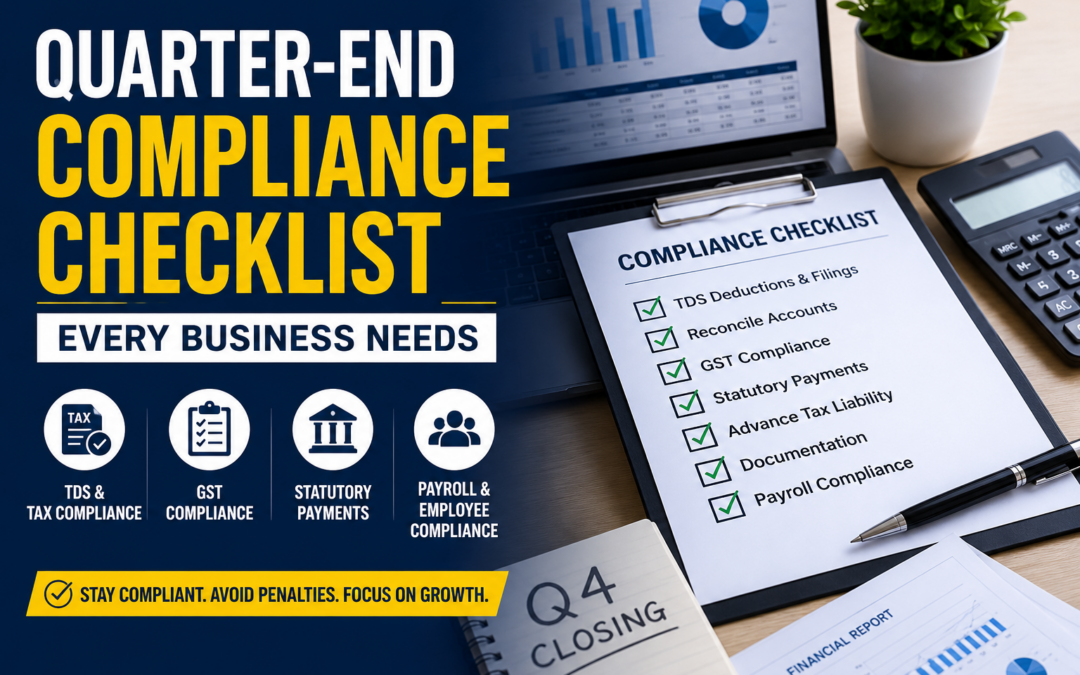
Quarter-end is not just about closing books—it’s about ensuring your business stays compliant, penalty-free, and audit-ready. Whether you’re a growing startup or an established enterprise, missing even a small compliance task can lead to financial and legal complications. A structured checklist can significantly impact the difference between a smooth close and last-minute chaos.
Here’s a practical quarter-end compliance checklist every business should follow to stay on track.
1. Review TDS Deductions and Filings
Start by verifying all Tax Deducted at Source (TDS) entries for the quarter. Ensure that:
- Correct rates have been applied
- PAN details of deductees are accurate
- All deductions are properly recorded
Once verified, proceed with timely return filing. Delays or errors can lead to penalties and notices, so accuracy is critical.
2. Reconcile Books of Accounts
Reconciliation is essential to maintain financial accuracy. Compare your:
- Bank statements
- Ledger balances
- Vendor and customer accounts
Identify mismatches and resolve them before the quarter ends. This helps avoid discrepancies during audits and ensures reliable financial reporting.
3. GST Compliance Check
Ensure all GST-related activities are completed:
- Match GSTR-1 and GSTR-3B data
- Verify input tax credit (ITC) claims
- Reconcile purchase and sales records
Incorrect GST filings can lead to blocked credits and compliance risks, so cross-checking is a must.
4. Verify Statutory Payments
Confirm that all statutory dues are paid on time, including:
- Provident Fund (PF)
- Employee State Insurance (ESI)
- Professional Tax
Late payments attract interest and penalties, impacting your business financially and legally.
5. Check Advance Tax Liability
Evaluate your business income and calculate any advance tax payable. Paying advance tax on time helps avoid interest under applicable tax provisions. It also ensures better cash flow planning for the business.
6. Documentation and Record Keeping
Organize all financial documents for the quarter, such as:
- Invoices
- Expense bills
- Contracts and agreements
Maintaining proper documentation ensures smooth audits and quick responses to any notices from authorities.
7. Payroll and Employee Compliance
Review payroll records and ensure:
- Salaries are processed correctly
- TDS on salaries is deducted
- Employee benefits and reimbursements are documented
Employee-related compliance is often overlooked but plays a key role in overall financial accuracy.
Conclusion
Quarter-end compliance doesn’t have to be stressful if approached systematically. With a clear checklist and timely action, businesses can avoid penalties, maintain accuracy, and stay fully compliant. More importantly, it allows teams to focus on growth rather than firefighting compliance issues.
Adopting the right tools and processes can further simplify this journey, making compliance not just a requirement—but a competitive advantage.
Recent Comments